




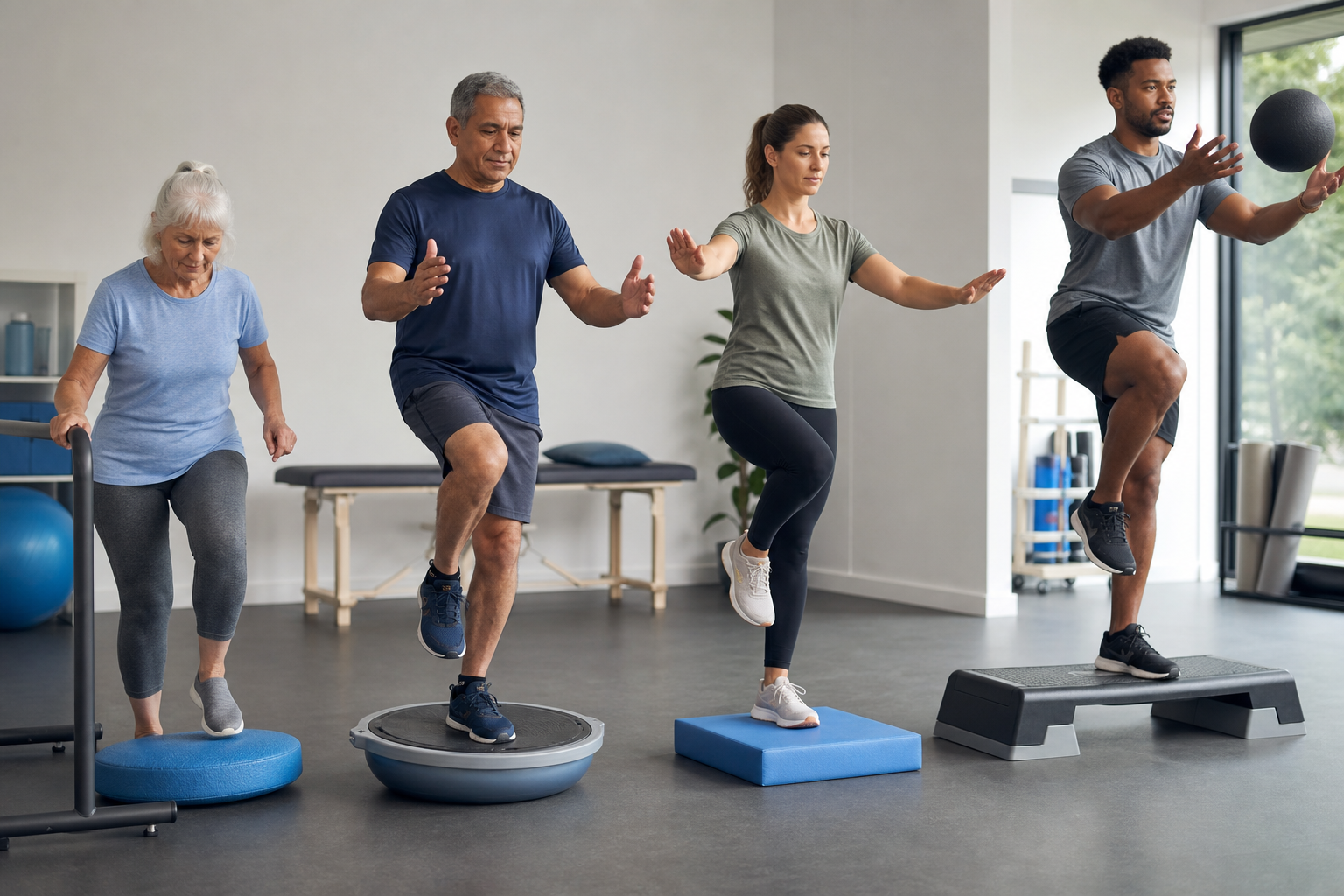
How do balance rehabilitation exercises progress from beginner to advanced?

How do balance rehabilitation exercises progress from beginner to advanced?
Key Takeaways
- Balance rehabilitation exercises progress through beginner, intermediate, and advanced stages to enhance stability and prevent falls.
- Safety checks are crucial before starting exercises, including consulting a healthcare professional if there are any underlying health concerns.
- Incorporating balance exercises into daily routines can significantly improve overall mobility and independence.
- Regular practice of balance exercises is essential for effectiveness, especially for older adults and those recovering from injuries.
- Utilizing a checklist can help track progress and ensure safety during balance rehabilitation.
Balance rehabilitation exercises follow a clear progression: restore a secure base, add movement and challenge, then integrate balance into everyday tasks. This step‑by‑step guide gives safe home exercises for beginner, intermediate and advanced stages, explicit stop points and safety checks, and clear signs for when to book an in‑clinic assessment in Markham. For related first-party details, review Strength Restoration Therapy in Markham | Proven Results.
Why balance rehabilitation matters for everyday safety and fall prevention
Improving balance reduces the chance of trips and falls and supports independence for daily activities. Canadian public health guidance recommends including activities that challenge balance alongside muscle‑ and bone‑strengthening exercises as part of weekly physical activity targets for older adults. Typical balance‑challenging activities include tai chi, standing on one foot and tandem walking, all of which can be incorporated as you progress through rehabilitation stages (physical activity your health.html).
Balance retraining ranges from re‑education of basic movement patterns to dynamic tasks that test the limits of stability. A progressive programme helps restore confidence and function after injury or deconditioning and is a recommended element of fall prevention strategies (preventing falls injuries older adults.html).
Safety rules and stop points before you begin
Follow these safety checks and absolute stop signals before and during balance exercises:
- Health check first: if you have a recent fracture, uncontrolled cardiac condition, recent stroke, severe vertigo, or other serious medical issue, consult your doctor before starting (physical activity your health.html).
- Create a safe environment: practise near a sturdy chair or countertop, on flat non‑slippery flooring, with clutter removed and good lighting.
- Use a spotter or light touch support for initial attempts. Keep support within arm’s reach rather than relying on it for full weight bearing.
- Absolute stop signals: sharp pain, fainting or near fainting, sudden severe dizziness that does not settle, repeated falls, or new neurological symptoms such as sudden numbness or slurred speech. If any occur, stop and seek prompt assessment (how lower your fall risk.html).
If you are unsure whether balance training is safe for you, speak with your family doctor or book an assessment with a physiotherapist or vestibular clinician.
Beginner exercises: build a stable base safely

Beginner work focuses on posture, weight acceptance and slow controlled shifts. Perform these with hands on a stable surface until you feel secure.
1. Supported weight shifts
Stand with feet hip‑width apart, hands lightly resting on a chair or countertop. Shift your weight slowly from one foot to the other, keeping knees soft and head level.
- Goal: controlled side‑to‑side weight transfer without stepping.
- Progression: when you can shift without tight gripping, reduce hand pressure and increase range.
- Stop: if you feel lightheaded or lose control of balance.
2. Heel raises with support
Hold a chair and slowly rise onto your toes, then lower back with control. This strengthens the calves and ankles, important stabilisers for standing balance.
- Goal: smooth ascent and descent with control.
- Progression: reduce hand support or perform controlled single‑leg heel raises when ready.
3. Marching in place
Stand tall and lift one knee at a time as if marching, keeping the trunk steady. Use support if needed.
- Goal: maintain upright posture while moving the legs.
- Stop: if dizziness persists for more than a minute after stopping.
4. Single‑leg stand with light touch
Stand beside a chair, lightly touch it with fingertips and lift one foot off the floor for a few seconds. Replace the foot gently and repeat on the other side.
- Goal: hold single‑leg balance while using minimal support.
- Progression: increase hold time and reduce fingertip pressure.
Intermediate exercises: add challenge and dynamic control
Progress to intermediate work once beginner tasks feel easy and you no longer grip supports tightly. Intermediate exercises narrow the base of support, introduce forward movement and controlled stepping.
1. Tandem stance and tandem walk
Tandem stance: stand with one foot directly in front of the other, heel to toe, using a support if needed. Tandem walk: take several heel‑to‑toe steps in a straight line.
- Goal: improve front‑to‑back stability and coordination.
- Progression: perform without hand support and maintain a steady gaze.
2. Heel‑to‑toe walking with head turns
Walk heel to toe while turning your head slowly left and right between steps. This challenges balance while the visual and vestibular systems adjust to movement.
- Goal: steady foot placement while the head moves.
- Safety note: stop and seek assessment if head turns produce severe or prolonged dizziness; a vestibular evaluation may be required (preventing falls injuries older adults.html).
3. Controlled stepping and reaching
Stand and reach forward, sideways or diagonally to touch a low object, then step back to the starting position. Focus on controlled weight transfer.
- Goal: improve anticipatory balance and reactive control.
- Progression: increase reach distance or reduce hand support.
Advanced exercises and functional integration

Advanced tasks train balance under time pressure, multi‑directional movement and reduced sensory input. Only attempt unstable surfaces with professional supervision. The final aim is to integrate balance into real activities such as stair negotiation, carrying items and walking on uneven ground (physical activity your health.html).
1. Single‑leg eyes closed and dual tasking
After single‑leg stands are reliable with eyes open, try brief single‑leg holds with eyes closed while lightly touching a support. Add a simple cognitive task, such as counting backward, to simulate everyday multitasking.
- Warning: have a spotter nearby and stop immediately with lightheadedness or loss of balance.
2. Multidirectional lunges with trunk reach
Perform controlled lunges forward, backward and diagonally, returning upright between repetitions. Reach with the opposite arm to integrate trunk control and coordination.
- Goal: build strength and dynamic balance for negotiating curbs or uneven surfaces.
3. Tai chi weight‑shift patterns and daily practice
Slow tai chi weight shifts and stepping patterns are evidence‑based for balance improvement and fall prevention. Practice patterns slowly and add them to daily walking or household tasks so gains transfer to real life (strength training balance activities canada historical trends prevalence.html).
- Safety note: take a supervised class if you are new to tai chi or have a significant balance impairment.
When should you book a physiotherapy or vestibular assessment in Markham
Arrange a professional assessment if you experience any of the following:
- Sudden, severe vertigo or ongoing unexplained dizziness that does not settle with rest.
- Repeated falls or near falls without a clear cause.
- Recent fracture, progressive weakness, numbness or new neurological signs.
- Little or no improvement after several weeks of safe practice, or exercises provoke severe symptoms.
Remarkable Physiotherapy in Markham provides physiotherapy and vestibular assessment as part of its multidisciplinary services. The clinic is open seven days a week and supports direct billing with major insurance companies to simplify payment. For a targeted assessment and a personalised progression plan, visit Remarkable Physiotherapy or call the clinic at +1 289-800-0441 to arrange an appointment.
Printable checklist and how to use it at home
Create a one‑page checklist to track safety, the exercises you complete and progression signals. Include these elements:
- Pre‑session safety checks: clear floor, chair nearby, good lighting, not rushed.
- Exercises performed: note stage (beginner, intermediate, advanced), support used, repetitions and any symptoms during or after the session.
- Progression log: date when an exercise felt easier, when you reduced support, or when you started a new exercise.
- Incident log: any loss of balance, dizziness, or pain to report at your next clinical visit.
Bring this checklist to a physiotherapy appointment so the clinician can tailor progression and investigate any underlying issues. If you would like help creating or reviewing a printable plan, request resources when you contact the clinic.
Frequently asked questions
When should I stop balance rehabilitation exercises and see a physiotherapist or doctor?
Stop and seek assessment immediately for sharp pain, fainting or near fainting, sudden severe dizziness that does not resolve, repeated falls, or new neurological signs. If balance does not improve after a few weeks of safe practice or you feel uncertain about progressing, book a physiotherapy assessment for a tailored plan (how lower your fall risk.html).
Are balance rehabilitation exercises safe for older adults and people recovering from injury?
Yes, when prescribed at the right challenge level and performed with appropriate safety measures. Public guidance supports balance‑challenging activities for older adults, but people with recent injuries or medical conditions should talk to a doctor or physiotherapist before starting (physical activity your health.html).
Can balance exercises reduce dizziness or are they only for fall prevention?
Some balance exercises can reduce dizziness, especially when dizziness is related to vestibular dysfunction. However, sudden or severe vertigo requires earlier clinical assessment. A vestibular physiotherapist can determine the right exercises to retrain balance and reduce dizziness.
How often should I practice balance rehabilitation exercises to see benefit?
Regular practice is important. Canadian guidance recommends including balance‑challenging activities within weekly physical activity targets for older adults, alongside strength and aerobic work. The precise frequency and progression should be personalised by a clinician based on your health and goals (strength training balance activities canada historical trends prevalence.html).
What should I bring to my first physiotherapy appointment in Markham for balance problems?
Bring your exercise checklist or log, a list of current medications, any recent medical reports, comfortable clothing and your questions. The physiotherapist will assess balance, gait and vestibular function and recommend a personalised progression plan.
Would you like an assessment and a tailored progression plan from a Markham physiotherapist who accepts direct billing and offers vestibular care?